How to Make Kung Pao Chicken
A simple recipe for classic Sichuan cuisine
Estimated cooking difficulty: ★★★★
Essential Ingredients and Tools
- Chicken thigh (or chicken breast)
- Green onion
- Dried chili peppers (or Erjingtiao chilies)
- Roasted peanuts
- Light soy sauce
- Chinese black vinegar (Chinkiang vinegar)
- Sugar
- Cooking wine
- Salt
- Chicken bouillon powder
- Cornstarch
- Vegetable oil
- Sesame oil
Optional Ingredients
- Chili oil
- Celtuce
- Raw peanuts
- Doubanjiang (broad bean paste)
Measurements
Note: This recipe is based on a single serving. It is sufficient for two people. For larger groups, simply double the quantities as needed.
- Required Ingredients
- Chicken thigh (or chicken breast) = 1 piece (approx. 350g)
- Green onion = 1 stalk (approx. 180g)
- Roasted peanuts = 150g
- Ginger slices = 10g
- Dried chili peppers (or Erjingtiao chilies) = 10g (if using Erjingtiao, use approx. 4 pieces)
- Light soy sauce = 10g
- Sugar = 2g
- Salt = 2g
- Vegetable oil = 20g
- Cornstarch = 15g
- Cooking wine = 15g
- Advanced Ingredients
- Dark soy sauce = 5g
- Sichuan peppercorns = 5g
- Chinese black vinegar = 5g
- Chicken bouillon powder = 2g
- Sesame oil = 10g
- Cornstarch (for thickening) = 10g
- Doubanjiang = 10g
- Optional Ingredients
- Celtuce = approx. 250g
- Chili oil = 5g
Use the above measurements as a baseline for ingredient ratios, adjusting to taste.
Instructions
Simplified Version
- Debone the pistol leg using scissors; flatten the chicken breast side with the back of a knife, cut into strips, and then dice into 1.5cm cubes. Soak in clear water for 10 minutes, then drain and set aside. (If using chicken breast, you can proceed directly to dicing and subsequent steps.)
- Place the green parts of scallions and 5g of ginger slices in a bowl, pour in 50g of boiling water, and set aside. Cut the white parts of the scallions into 1.5cm round pieces and set aside. Place peanuts in a microwave and dry them on high power for 5 minutes, then set aside.
- Add 2g of salt, 5g of dark soy sauce, 15g of cooking wine, and 15g of cornstarch to the diced chicken. Mix well until the mixture is slightly dry. Slowly add some of the scallion-ginger water, stirring the chicken until it becomes sticky. Seal with plastic wrap and marinate in the refrigerator for 1 hour.
- Cut dried chilies into segments. Heat a wok, start with high heat and then reduce to low. Add the dried chilies and dry them until slightly charred, then remove and set aside. Dry the Sichuan peppercorns until fragrant, then remove and set aside.
- Increase the heat to high, pour in 20g of vegetable oil, and heat until 70% hot (bubbles form when a bamboo chopstick is inserted). Add the diced chicken and pan-fry until the top starts to turn white. Flip with a spatula, fry for 30 seconds, then stir-fry evenly.
- Add the scallion pieces and stir-fry. Add the remaining scallion-ginger water; if it is less than 100g, add a little more water (must be hot water). Cover the lid, reduce to medium-low heat, and simmer for 2 minutes.
- Increase the heat to high, add the roasted peanuts, dried chilies, and Sichuan peppercorns. Add 2g of chicken bouillon, 5g of fragrant vinegar, and 2g of sugar. Stir-fry evenly.
- Mix 10g of cornstarch with 50g of clear water to make a slurry. Add to the wok, stir-fry evenly, and reduce the sauce to your desired consistency.
- Turn off the heat, drizzle in 10g of sesame oil, and serve.
A slightly more complex but more appetizing version
Compared to the simple version, it is more recommended to use Erjingtiao chilies and raw peanuts. Additionally, lettuce is added to complement the crispness of the peanuts and the tenderness of the chicken.
- Peel the celtuce, cut it into 1cm cubes, and set aside;
- Cut the Erjingtiao chilies into 1cm segments;
- Debone the drumstick using scissors, then pound the chicken side with the back of a knife. Cut into strips and then into 1.5cm cubes. Soak in clear water for 10 minutes, then drain and set aside (if using chicken breast, you can proceed directly to cubing and the subsequent steps);
- Place the green parts of the green onion and 5g of ginger slices in a bowl, pour in 50g of boiling water, and set aside. Cut the white parts of the green onion into 1.5cm round pieces and set aside;
- Add 2g of salt, 5g of dark soy sauce, 15g of cooking wine, and 15g of cornstarch to the chicken cubes. Mix well until the mixture becomes slightly dry. Slowly add some of the green onion and ginger water, stirring the chicken cubes until they become sticky. Cover with plastic wrap and marinate in the refrigerator for 1 hour;
- Heat the pan over medium heat, add 20g of vegetable oil, and stir-fry raw peanuts until their surfaces are slightly charred. Remove the peanuts but leave the oil in the pan;
- Continue heating until the oil reaches 70% heat (bubbles form around a bamboo chopstick). Add the chicken cubes and doubanjiang (broad bean paste), and stir-fry for about 1 minute;
- Add the prepared celtuce cubes and continue stir-frying for 1 minute;
- Add the green onion pieces and stir-fry. Add the remaining green onion and ginger water (if it doesn't reach 100g, add a little more hot water—ensure it is hot). Add the Erjingtiao chili segments. Cover the pot, reduce the heat to medium-low, and simmer for 2 minutes;
- Increase the heat to high. Add the previously reserved peanuts and Sichuan peppercorns. Add 2g of chicken bouillon, 5g of aromatic vinegar, and 2g of sugar. Stir-fry evenly;
- Mix 10g of cornstarch with 50g of water to make a slurry. Add it to the pan and stir-fry evenly until the sauce reaches your desired consistency;
- Turn off the heat, drizzle in 10g of sesame oil and 5g of chili oil, and stir-fry for another 10 seconds before serving.
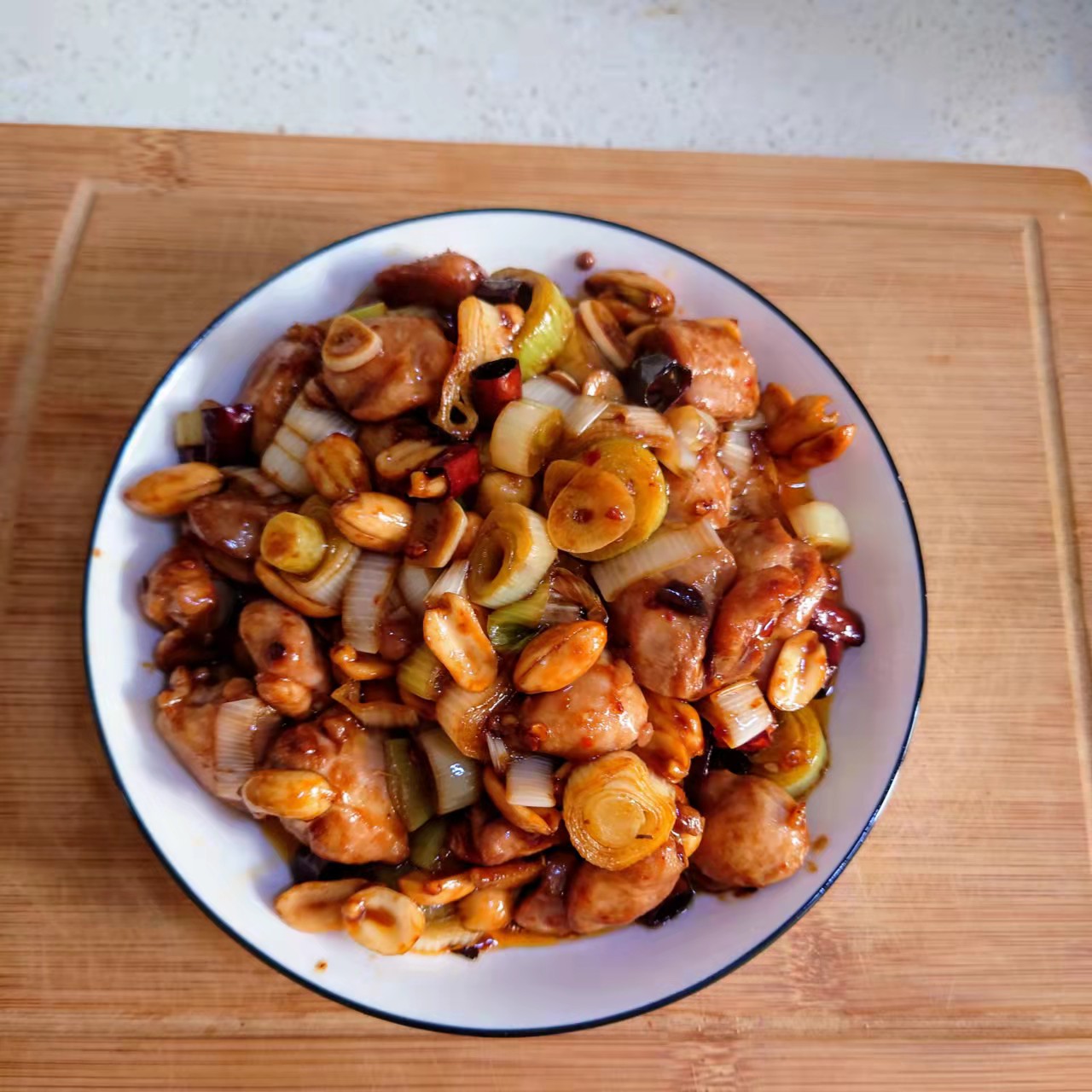
Additional Notes
Add chili peppers according to personal preference; remove seeds if you prefer less spiciness.
If you follow the production process in this guide and find any issues or have suggestions for improvement, please submit an Issue or Pull request.